About
Guiding Aspiring Professionals in Building Maritime Careers
There are three departments on most ships.
The Steward Department:Any entry-level Mariner can qualify for this department. If you have cooking experience, cook jobs are plentiful and in demand. This department maintains the interior of the ship, cleans, takes care of ship supplies, and of course, food preparation.
Be prepared to have to start in the Steward Dept. with some companies. You can transfer to the Deck or Engine Dept. from within.
The Deck Department:Entry-level jobs in this department are ordinary seamen or deckhands. The Deck dept. maintains the exterior of the ship, like chipping and painting, for instance, standing navigational watch on the bridge, assist with cargo movement, rigging and is responsible for getting the ship to its destination. This outdoors work most of the time so if you like the outdoors the deck dept. is where you want to be. The Engine Department:
Entry-level jobs in this department are wipers and engine utilitymen. The Engine Department takes care of the engines and all mechanical equipment on board. The engine department has the most positions in a department. If you have a mechanical background this is your way in to a great career.
The way you move up in rating and pay scale is through sea time in a department. The engine room has the most ratings, and you can move up very quickly. In just six months of sea time, you can obtain your first rating and double your income.
I
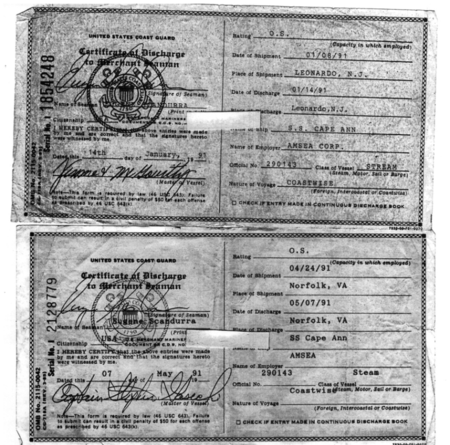
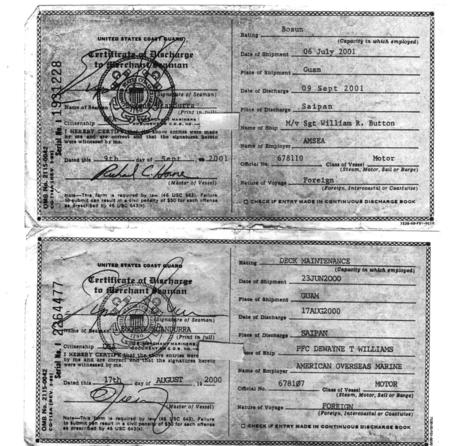
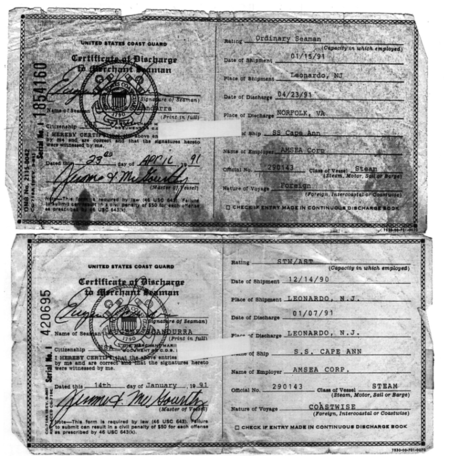
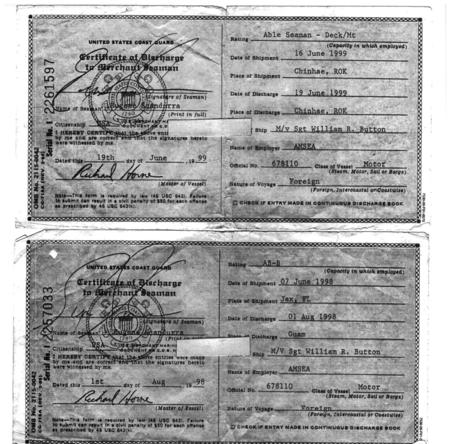
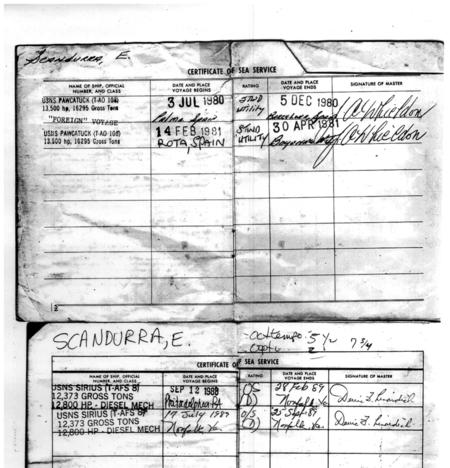
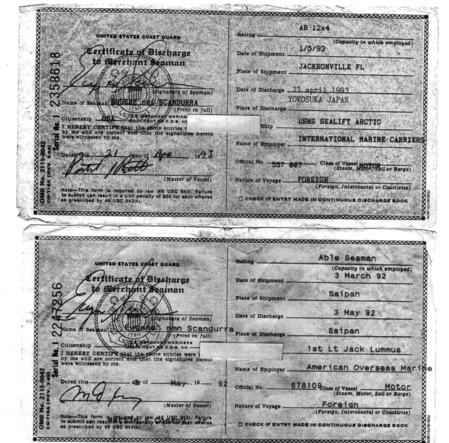
Below are a few of my Mariner Discharges. Everytime you get off a rotation you will receive a discharge. The way a Merchant Mariner moves up into rating / ladder is through time on the vessel / on rotation. In as little as six months you can obtain your first rating. Once you have a rating your pay doubles and you have full control of your career. The way you prove your time on a vessel is through your discharge. Some companies use a letter head for disclosing your time and job description on there vessels. The discharge shows the vessels information, such as registration and type of vessel, where you got on board the vessel, what job you did on the vessel, and where you got off the vessel. When you have the required time for your rating in either the deck or engine departments you submit your discharges as proof of your Seatime. You will receive plenty of training on board the vessel. Never lose your discharges or your credentials they are difficult to recover ! Below are some of my discharges. I worked for many different companies before taking a permanent position. I enjoyed traveling to different places and experiencing different vessels. I will pass that knowledge and experience onto you. The Cape Ann was the vessel I took to the Persian Gulf War in 1991. Keep an EYE out for my book The Cape Ann. Its a true story how a bunch of entry level misfits came together to learn how to rig and operate a World War II stick ship and deliver the bombs that took out Iraq!
Fair Winds and Following Seas!
My Merchant Mariner Discharges